What does it actually take to make a functional beverage safe, stable, and still worth drinking twelve months later? Derek Greer speaks on pasteurization, microbiological validation, vitamin degradation, protein and flavor interactions, and the industrial production of B vitamins in his interview.
"You do not want to be standing in front of a tank of 30,000 gallons and it's wrong."
Watch his full interview
Most brands plan for whether a drink can hurt someone. Fewer plan for whether anyone will still want to drink it at the end of its shelf life. Both are chemistry problems, and they rarely have the same answer.
In 1996, unpasteurized apple juice from Odwalla carried E. coli. At least 66 people got sick. Fourteen children developed life-threatening kidney ailments. A sixteen month old girl in Denver died. Odwalla pleaded guilty to sixteen counts of selling adulterated food and paid a $1.5 million fine, the largest in a food injury case in FDA history.1
One decision about whether to apply heat changed Odwalla’s history.
This is what makes the functional beverage category unlike most others. A beverage is not finished when the formula is approved. It keeps reacting inside the package for months, and every one of those reactions was set in motion by choices made at the bench: the pH, the thermal process, the actives, the packaging.
This is where consumers’ health should be prioritized over any extra cost. A pH held below the pathogen threshold, a thermal process validated against the right organism, a shelf life set to what the actives can survive, are all important decisions that keep a product safe long after it leaves the plant. Get them right and the risk is controlled before a single bottle is filled. Skip them and the consequences could be worse than what Odwalla experienced.
Obviously, it’s important to pasteurize your juice, but industry standards have changed to pasteurizing juice not once but twice.
The FDA's position is straightforward: unless the produce or the juice has been pasteurized or otherwise treated, the product may be contaminated, and untreated packaged juice must carry a warning label naming children, older adults, and immunocompromised consumers as the populations at risk.2
The industry went further than the FDC’s label requirement. Juice processing once relied on aseptic transfer, where the product was pasteurized a single time and then moved into a holding tank until packaging. That model has largely been replaced by double pasteurization: once on receiving, and again immediately before the fill.
The reason is the interval between those two points. One kill step confirms the product was sound at the moment it was treated and at no point after. Transfer lines, tank residence time, and the fill itself are all opportunities for something to get back in. A second thermal process just before the package seals closes that window.
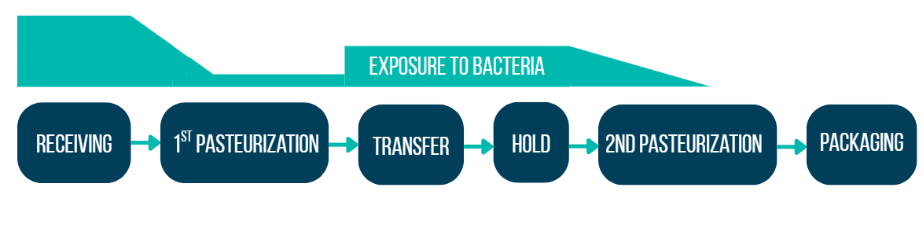
The cost is flavor. Juice is thermally fragile and passing it through heat twice does measurably more damage than passing it once. The two processes do not produce the same product in the glass.
That tradeoff sets the pattern for everything downstream. A safety decision is rarely only a safety decision, and knowing what a process does to flavor chemistry is what makes the cost recoverable.
No formulator sets out to make an unsafe product. The difference between a safe beverage and a validated one is whether anyone can prove it. As we have seen, the consumers’ safety is held to a high standard. We see this further in microbiological validation. It is required, not recommended, and which products it applies to comes down to chemistry.
Every safe beverage falls into one of three categories, and the category determines how much validation work stands between formulation and production.
Execution is where the risk concentrates. A formulator builds the safety margin into the formula, but the co-manufacturer is the party that has to hit it. Missing the specified temperature by a single degree means the product was never validated at all.
Wouldn’t it be great if we could stock up on nutrients years ahead of using them? Unfortunately, chemistry has some rules to follow.
Ascorbic acid is among the least durable ingredients a formulator can put into a beverage. It is highly sensitive to heat, and the loss compounds over time rather than stopping once the product cools.
"You could put it in at 100%. But after a thermal process and a few weeks of age, you have almost no vitamin C left."
The chemistry explains why the loss is permanent. Ascorbic acid oxidizes first to dehydroascorbic acid, which then degrades further into a series of reactive compounds including 2,3-diketogulonic acid, 3-deoxythreosone, xylosone, and threosone. Those products are not inert remnants. They participate in nonenzymatic glycation, the same Maillard chemistry responsible for browning, meaning degraded vitamin C continues to drive reactions in the product after it has stopped functioning as a vitamin.4
This creates a labeling problem rather than a safety problem. A nutrition facts panel is a claim about the entire shelf life, not the fill date. Whatever is declared on day one must still be present on day 365. If ascorbic acid cannot survive that interval at the declared level, a formulator has two options:
• Leave it out, and build the formula around actives that survive the process
• Shorten the stated shelf life, so the label remains accurate for as long as the product is sold
Antioxidants slow the process without stopping it. Compounds such as tocopherols and rosemary extract are added specifically to be oxidized first, absorbing oxidative load that would otherwise reach the vitamins and flavor compounds. They buy time rather than confer permanence.
The practical result is that functional beverages generally carry shorter shelf lives than conventional ones, often in the range of nine to twelve months. A drink without thermally unstable actives can run considerably longer. The vitamin does not determine whether the product is safe. It determines how long the label stays true.
Derek is skilled in food science, product development, manufacturing, food safety and scale-up commercialization
A flavor that tasted perfect in water can arrive flat once the protein goes in. Nothing was done wrong. The protein is simply holding onto part of it.
Proteins are large, chemically active molecules, and in a beverage they do considerably more than deliver grams on a panel. They bind flavor compounds directly, through ionic bonds, hydrogen bonds, hydrophobic interactions, and physical adsorption. Most of those bonds are reversible. A smaller number, such as the covalent binding of aldehydes to lysine side chains, are effectively permanent. The balance between flavor that stays bound and flavor that releases is what determines how a protein containing product is ultimately perceived.5
The practical consequence is that a protein absorbs aromatic compounds into its own structure, muting notes that would otherwise be present. A flavor system that performs in a water base will not perform the same way once protein is introduced, because a portion of the aromatics is no longer free to be perceived.
pH introduces a harder limit. Every protein has an isoelectric point, the pH at which it carries no net charge and loses the electrostatic repulsion that keeps it suspended. At that point the protein flocculates and settles to the bottom, or creams and collects at the top. Neither outcome is recoverable through flavor work.
This is why certain product concepts cannot be formulated regardless of budget. Carbonating milk is chemically impossible to make shelf stable. Carbonation drives the pH down toward and past the isoelectric point of milk protein. The same reaction is visible in dirty sodas, where milk added to a low pH soda begins curdling almost immediately. The format works in a shop because the shelf life is measured in minutes. It does not survive twelve months in a can.
"There's a balance between chemistry and what's physically possible chemically and what the idea is."
Consumers often decide for themselves what to believe about ingredients, and that belief tends to rely more on what they hear than proven science.
Commercial B vitamins are produced by bacterial fermentation. It is the established production route, not a workaround or a recent cost-saving measure.
The microbiology is well characterized. Lactic acid bacteria synthesize several B group vitamins, with the most studied being folate, or vitamin B9, and riboflavin, or vitamin B2. Cobalamin, vitamin B12, is the only vitamin of exclusively microbial origin, synthesized by certain bacteria and archaea, with Propionibacterium freudenreichii the organism most associated with its production. Microbial synthesis is regarded as a sustainable alternative to chemical production rather than a compromise.6
"I had somebody say to my face with absolute legitimacy, telling me that B vitamins are made from sewage... But I guarantee you B vitamins are not made from sewage. But he believes that. And he tells people this."
The confusion appears to stem from the word fermentation and its association with waste treatment, but the two processes share nothing beyond the involvement of bacteria. Commercial vitamin fermentation uses defined microbial strains grown on controlled feedstocks under conditions closer to pharmaceutical manufacturing than anything else.
There is also a formulation footnote worth noting. Unlike ascorbic acid, B vitamins are stable over long periods. They tolerate thermal processing and extended storage without meaningful degradation, which makes them among the more reliable actives to declare on a panel and expect to still be there at the end of shelf life.
1 CBS News 1998 $1.5M Fine In E. coli Outbreak
2 U.S. Food and Drug Administration. What You Need to Know About Juice Safety
3 Giardino N (2024) The Impact of Food Processing on Microbial Safety: Testing and Validation. J Anal Bioanal Tech 15: 694.
4 Nemet I, Monnier VM. Vitamin C degradation products and pathways in the human lens. J Biol Chem. 2011 Oct 28;286(43):37128-36.
5 Qian R, Sun C, Bai T, Yan J, Cheng J, Zhang J. Recent advances and challenges in the interaction between myofibrillar proteins and flavor substances. Front Nutr. 2024 Apr 25;11:1378884.
6 Keyvan E, Adesemoye E, Champomier-Vergès MC, et al. Vitamins formed by microorganisms in fermented foods: effects on human vitamin status, a systematic narrative review. Front Nutr. 2025;12:1653666.
Test Your Formula fromwith Experts in Shelf-life and Quality!